

About
Genofibrix is a university-based startup that advances the development of novel formulations and materials in the pharmaceutical, cosmetic, and food fields using nanofiber technology.
Based on the research achievements of the Laboratory of Nanofiber Technology at Gifu Pharmaceutical University, we aim to realize the social implementation of nanofiber-based formulation technologies.
Mission
Solution by Nanofiber
Through nanofiber technology, we aim to innovate formulation technologies in the pharmaceutical, biomedical, cosmetic, and food sectors and accelerate their practical application.
We contribute to a healthier future society through the integration of knowledge, industry–academia collaboration, and an entrepreneurial mindset.
Company Profile
| Company Name | Genofibrix Co., Ltd. |
|---|---|
| English Name | Genofibrix Co., Ltd. |
| Address | 1-25-4 Daigaku-nishi, Gifu City, Gifu, Japan |
| Founded | June 17, 2025 |
| Representative | Koji Hara, CEO |
| Business | Research and development of cosmetics, pharmaceuticals, medical devices, and food materials using electrospinning and related methods |
Members
Koji Hara
- Project Associate Professor, Gifu Pharmaceutical University
Kohei Tahara
- Professor, Gifu Pharmaceutical University
Yoshiaki Ogasawara
History
| April 2022 | Establishment of the Laboratory of Nanofiber Technology at Gifu Pharmaceutical University |
| June 2025 |
Genofibrix Co., Ltd. founded; currently promoting joint and contract research through industry–academia collaboration |
Technology
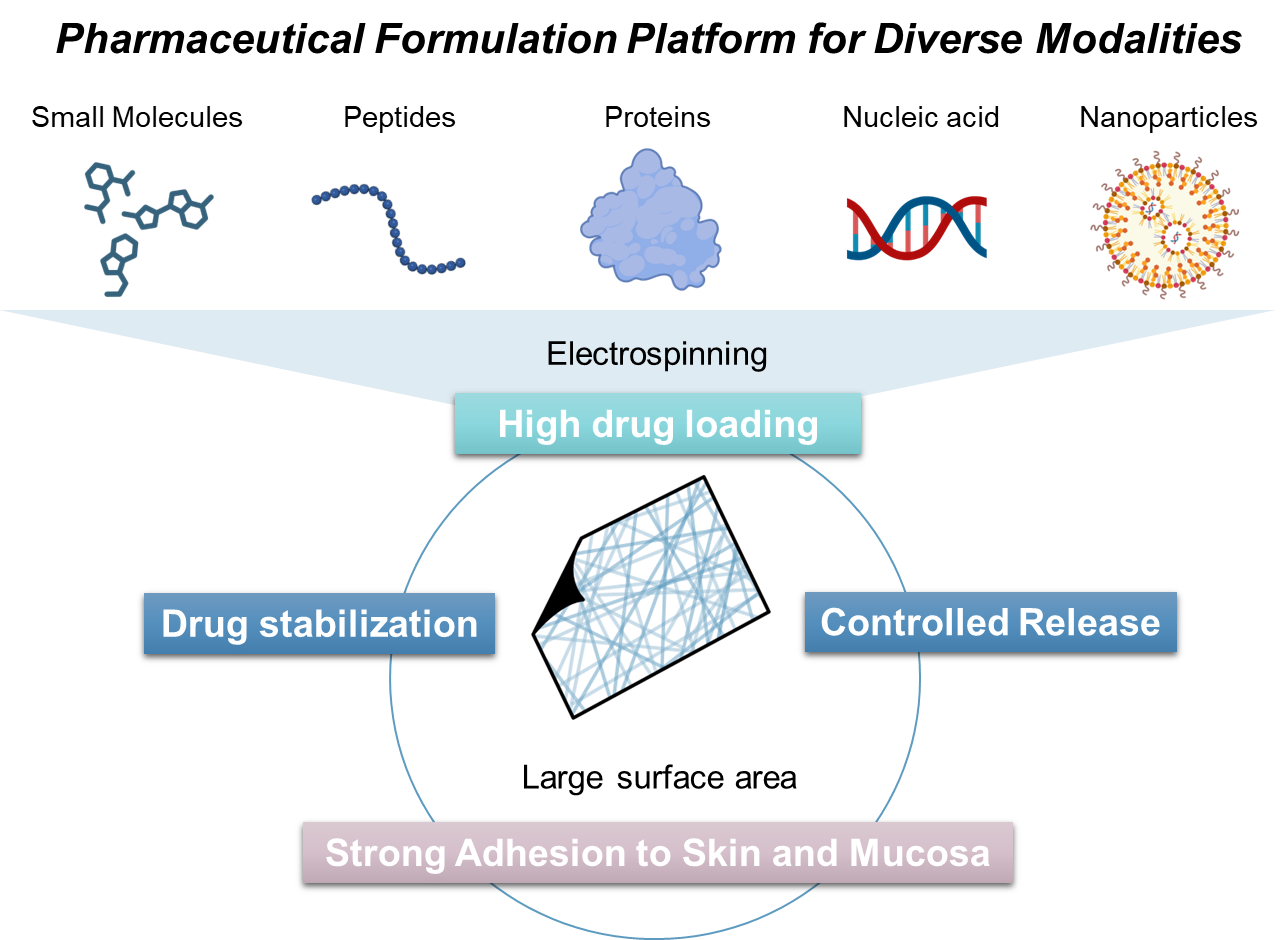
We utilize polymeric nanofibers as drug delivery systems (DDS) and conduct formulation research to create new dosage forms in pharmaceutical, food, and cosmetic applications.

- High drug loading
- Enables efficient encapsulation of diverse modalities including small molecules, peptides, proteins, and nucleic acid therapeutics
- Stabilization & Solubility
- Provides drug stabilization and improves solubility through amorphization in the nanofiber matrix

- Controlled release
- Allows controlled drug release by tuning polymer properties or fiber structures such as core–shell types
- Strong adhesion
- High porosity and surface area result in strong adhesion to skin and mucosal tissues
Characteristics of Nanofibers
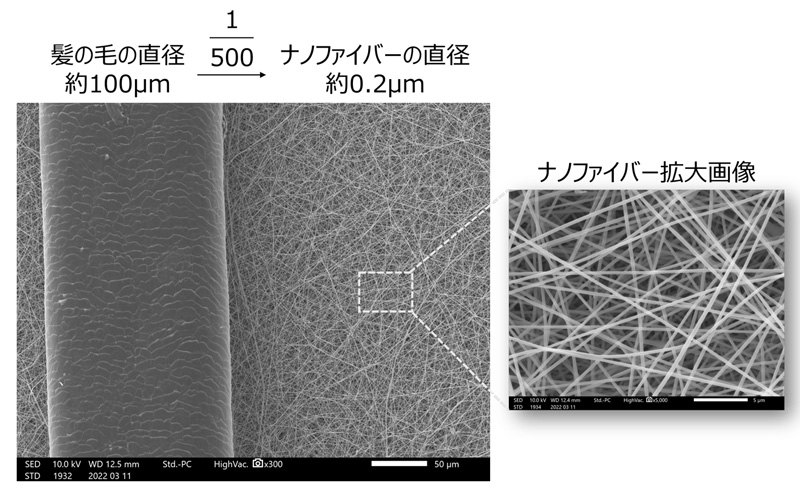
Polymeric nanofibers are submicron-scale fibers with diameters of several hundred nanometers—approximately one five-hundredth the thickness of a human hair. Nanofibers have been investigated for a wide range of applications not only in the medical field but also in industrial sectors. Due to their extremely small diameter, nanofibers possess a much larger surface area compared to bulk polymers. Sheets (mats) composed of nanofibers are highly porous, yet they exhibit enhanced mechanical properties, offering unique and intriguing physicochemical characteristics.
Electrospinning
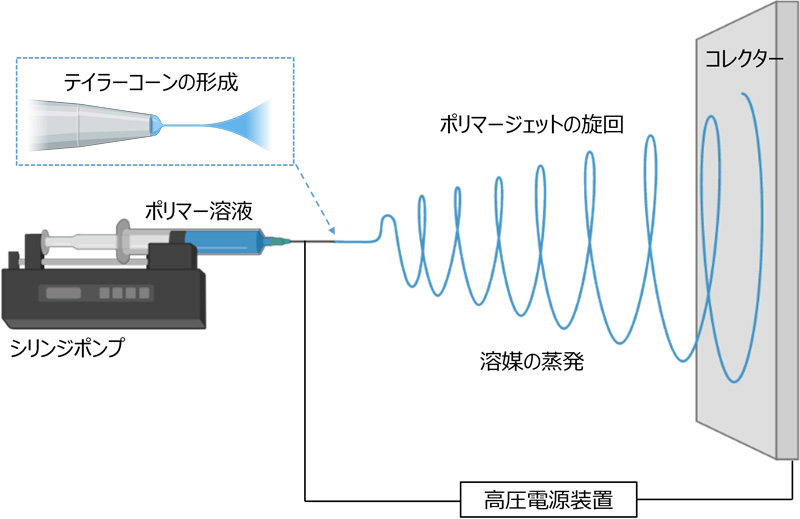
Electrospinning, a widely used method for producing nanofibers, enables the continuous fabrication of nanofibers directly from liquid feed solutions under laboratory conditions. Because this process can solidify materials into fibers continuously without the use of heat, it is considered advantageous for pharmaceutical applications, where many compounds are physicochemically unstable and sensitive to thermal stress.
Business Areas & Pipeline
Research and Development Fields
-
Pharmaceuticals
Mucosal delivery formulations, Solid dispersion formulations, Peptide and nucleic acid therapeutics, Sustained-release formulations -
Medical Devices
Wound dressings, Surgical sheets -
Cosmetics
Nanofiber beauty sheets -
Food & Functional Ingredients
Controlled-release materials, Stabilization of functional ingredients
Publications
- Arakawa, S., Hara, K., Koide, Y., Yamada, M., Yamazoe, E., Ito, T., Tahara, K., 2025. Enhanced solubility and controlled release of probucol using electrospun nanofibers prepared with different pharmaceutical polymers. Pharm. Dev. Technol. 1–17.
- Ito, T., Uda, S., Taie, Y., Kamiya, Y., Yamazoe, E., Hara, K., Tahara, K., 2025. Instant-gelling electrospun polyvinyl alcohol nanofiber mats for enhanced retinal drug delivery via topical ocular application. Int. J. Pharm. 126128.
- Yavari, A., Ito, T., Hara, K., Tahara, K., 2025. Comparative Analysis of Needleless and Needle-Based Electrospinning Methods for Polyamide 6: A Technical Note. Chem. Pharm. Bull. 73, 18–24.
- Iwai M, Yamazoe E, Ito T, Hara K, Tahara K. Design of an oral formulation combining PVA nanofibers and PEGylated liposomes for enhanced drug delivery. J. Drug Deliv. Sci. Technol. 101, 106285. 2024
- Miki A, Hara K, Shibata T, Morioka T, Kobayashi A, Yoshimura N, Yamazoe E, Ito T, Tahara K. Development of a solid dispersion system for polyvinyl alcohol nanofibers embedded with silicon dioxide particles via emulsion electrospinning for improved solubility of poorly water-soluble drugs. J Drug Deliv Sci Technol. 99: 105915. 2024
- Ito T, Tamashiro S, Okuda H, Yamazoe E, Tahara K. Cryomilled electrospun nanofiber mats containing d-mannitol exhibit suitable for aerosol delivery of proteins. Int J Pharm. 661: 124425. 2024.
- Kanamori M, Hara K, Yamazoe E, Ito T, Tahara K. Development of Polyvinyl Alcohol (PVA) Nanofibers Containing Cationic Lipid/siRNA Complexes via Electrospinning: The Impact of PVA Characterization. Nanomaterials. 14: 1083. 2024.
- Ogawa R, Hara K, Kobayashi A, Yoshimura N, Taniguchi Y, Yamazoe E, Ito T, Tahara K. Controlled Release of Lysozyme Using Polyvinyl Alcohol-Based Polymeric Nanofibers Generated by Electrospinning. Chem. Pharm. Bull. 72: 324-329. 2024.
- Ito T, Yamazoe E, Tahara K. Dry Powder Inhalers for Proteins Using Cryo-Milled Electrospun Polyvinyl Alcohol Nanofiber Mats. Molecules. 27: 5158. 2022
- Shibata T, Yoshimura N, Kobayashi A, Ito T, Hara K, Tahara K. Emulsion-electrospun polyvinyl alcohol nanofibers as a solid dispersion system to improve solubility and control the release of probucol, a poorly water-soluble drug. J Drug Deliv Sci Technol. 67: 102953. 2022